
Apple, Spanish, and the Art of Dressing Power as a Playlist
Apple at the summit of the global music market
Apple has reached a position where it no longer behaves like a company competing in a sector but like a structural actor shaping it. With a market capitalization oscillating around USD 3,000,000,000,000, Apple functions as an ecosystem rather than a brand. Inside that ecosystem, Apple Music is not simply a streaming platform but a long-term cultural infrastructure.
Apple Music counts between 90,000,000 and 100,000,000 subscribers worldwide, making it the second largest music platform globally. But the figure that matters is not the subscription count. It is the position Apple Music occupies inside devices, operating systems, payments, cars, homes and daily routines. Music here is not content. It is habit, continuity and loyalty without ideology.
The Super Bowl move: presence without ownership
When Apple Music became the official title sponsor of the Super Bowl Halftime Show, the move was publicly framed as branding. In reality, it was a demonstration of contemporary power logic.
Apple does not produce the show. Operational control remains with the National Football League and Roc Nation. Apple purchases the name, the narrative frame, the global amplification and the afterlife of the performance. What it avoids is creative control and political exposure.
This is Apple’s constant method. Maximum visibility. Minimum liability.
América as a single cultural body
What made this halftime show structurally different was not spectacle but geography. The show reclaimed América as a continent, not as a hierarchy and not as a fragment.
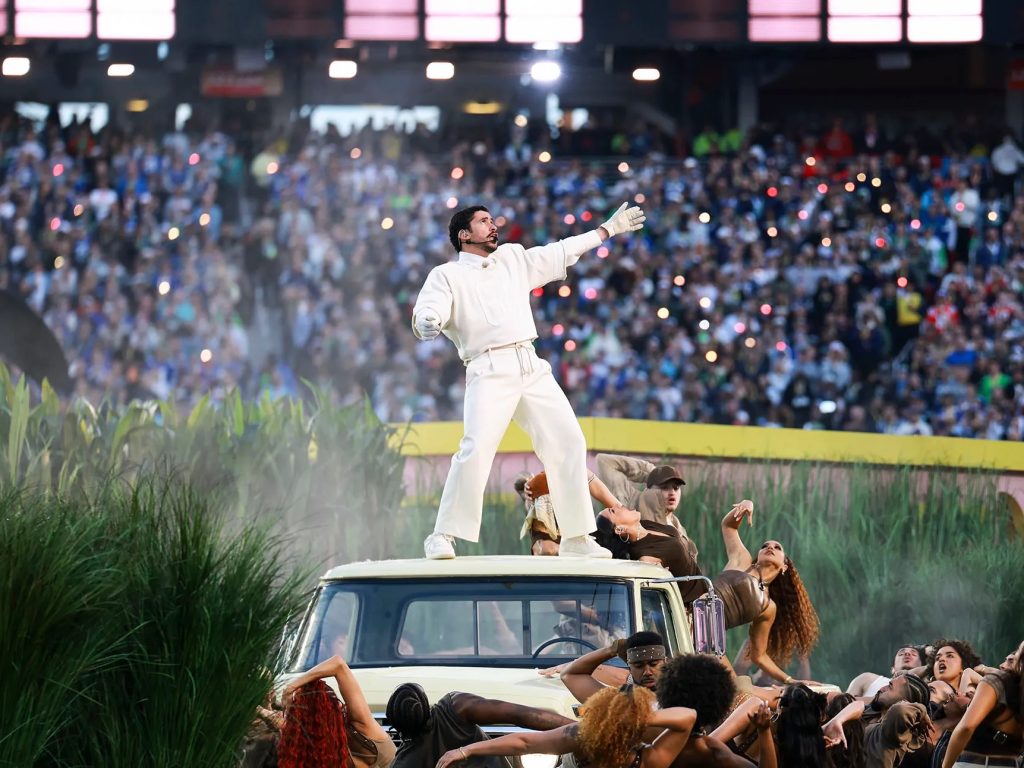
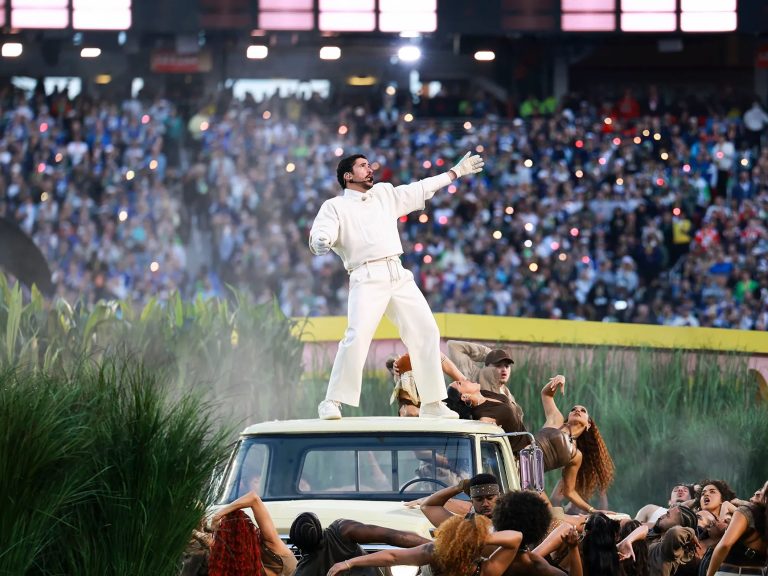
The artist, Bad Bunny, appearing under his full name Benito Antonio Martínez Ocasio, closed the performance by naming the countries of the Americas as a continuous space: Chile, Argentina, Uruguay, Paraguay, Bolivia, Perú, Ecuador, Brasil, Colombia, Venezuela, Guyana, Panama, Costa Rica, Nicaragua, Honduras, El Salvador, Guatemala, México, Cuba, República Dominicana, Jamaica, Haiti, the United States, Canada, and Puerto Rico, ending with Puerto Rico not as a footnote but as origin.
This was not a list for decoration. It was a declaration of continental identity. Spanish was not presented as minority language or cultural ornament. It appeared as what it already is: a shared language of the Americas, historically rooted and demographically irreversible.
There was politics in that gesture, but not the kind that asks permission. Language itself did the work.
The political layer: Washington, regulation and survival
This cultural clarity does not contradict Apple’s political pragmatism. In the political layer, Apple behaves like a nation-scale corporation.
It optimizes survival across administrations.
It avoids burning bridges.
It navigates regulation, antitrust pressure and trade dependencies with transactional discipline.
Its proximity to Trump-era power structures, including Donald Trump, was never ideological. It was logistical. Apple assumes, correctly, that administrations are cyclical. Political climates shift. Language does not.
Spanish as structure, not decoration
Outdated statistics underestimate the scale of Spanish today. Spanish now counts more than 620,000,000 native speakers worldwide. When second-language and near-native speakers are added, the figure exceeds 800,000,000 people. If functional fluency across Europe, the Americas and parts of Africa is considered, Spanish operates as the most widely shared spoken language in everyday global life.
The comparison with Chinese as it is commonly named is instructive. What is often referred to as “Chinese” is not a single language but a family of more than one hundred languages and dialects, many of them mutually unintelligible. What political centralization presents as linguistic unity is, in reality, fragmentation managed by power. Spanish, by contrast, travels intact across continents, remains mutually intelligible across borders and generations, and scales without translation or mediation.
From a corporate perspective, this coherence is power.
Layered power and corporate lucidity
Apple’s strategy is layered rather than ideological.
At the top, compliance.
At the base, expansion.
Culture functions as lubricant.
Politics is treated as weather.
Betting on Spanish does not confront power. It survives power.
Apple understands that empires today do not march. They normalize. They enter homes through playlists, routines and familiarity until they feel inevitable.
Identity, voting and the danger of self-erasure
Here lies the unresolved fracture. Language and demographic weight only translate into real power if those who carry them understand their value and act accordingly. Too often Spanish-speaking societies are fragmented by misinformation, fear and short-term narratives.
This is not limited to the United States. It is visible in Europe and, with particular intensity, across South America. Voters are persuaded to support parties and candidates whose economic and social programs work directly against their own material existence and future.
The final paradox is brutal. We end up with Latinos enforcing systems designed to exclude them, wearing uniforms that do not protect them, applying policies that damage their own communities. Power rarely arrives as an enemy. More often, it arrives disguised as order.
What Apple understands better than most
Apple is not progressive. It is not conservative. It is not neutral. It is lucid. It understands that politics passes but culture accumulates. It knows how to dress empire, and even the emperor, as a playlist.
And as the Spanish refranero warns,