
Baghdad 1258 — Destruction as Method
In 1258, Hulagu Khan entered Baghdad. This is the decisive starting point.
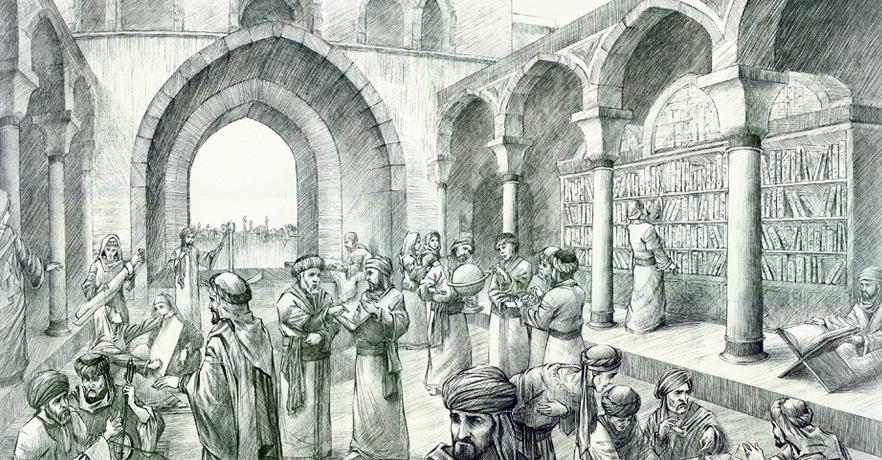
Baghdad, founded by Al-Mansur as Madinat al-Salam, the City of Peace, had for centuries been one of the principal centres of knowledge of its time. Its libraries, scholars, and translation movements connected Greek, Persian, Indian, and Arab traditions into a continuous intellectual system.
The Mongol conquest did not simply replace political authority. It interrupted that continuity. The city was dismantled as a functioning organism. Its population was devastated. Its intellectual infrastructure collapsed. What had been accumulated over centuries was broken in a matter of days.
The Mongol expansion operated through a combination of military precision and systematic destruction. Across Eurasia, entire regions were depopulated. Estimates vary, but it is widely accepted that tens of millions of people—often cited above thirty million—were killed during the Mongol campaigns up to the mid-13th century.
This expansion produced a form of order across vast territories, sometimes described as a Pax Mongolica. The expression obscures the mechanism behind it. Rome, after conquest, imposed structure through law, administration, and infrastructure, but its campaigns were also marked by destruction of resisting cities. The Mongol system went further. It frequently established control by eliminating resistance through large-scale killing and devastation, transforming entire regions into spaces where opposition had ceased to exist.
In contrast, the early Arab expansion followed a different model. It was based on incorporation, negotiated submission, and relative protection of non-military populations under defined legal frameworks. Urban continuity was, in many cases, preserved rather than erased.
The Mongol advance represented the most radical form of expansion within this spectrum. Land burned, populations reduced, resistance removed at its root.
For decades, this mechanism appeared without limit.
Ain Jalut 1260 — The First Limit
On 3 September 1260, at the Battle of Ain Jalut, in Palestine within the Arab Levant, the Mongol advance encountered a different form of power.
This region functioned as the strategic extension of Egypt’s defensive and military system. It was the space where threats were confronted before reaching the Egyptian centre.
The force that opposed the Mongols was not based on lineage or inherited aristocracy. It was constructed.
The Mamluk system relied on the deliberate formation of a military elite. Young men, many from Turkic and steppe regions shaped by the same geopolitical movements that had enabled Mongol expansion, were brought, converted, trained, and integrated into a disciplined hierarchy of command.
They formed a multicultural army operating under a unified structure.
Among their leaders stood Saif ad-Din Qutuz and Baibars. Both had passed through enslavement. Both had been shaped by displacement and transformation. Their knowledge of steppe warfare was internal, not theoretical.
Facing them was Kitbuqa, commanding a Mongol force that had imposed its operational logic across continents.
The battle was not accidental. Baibars deployed the feigned retreat, a tactic associated with Mongol warfare, and inverted its function. The Mongol forces were drawn into a controlled engagement where their cohesion could be disrupted. Qutuz maintained the internal structure of command at the decisive moment.
Kitbuqa was killed. The Mongol army was defeated.
For the first time in their westward expansion, the Mongols did not advance.
They encountered a limit.
Egypt — Structure Against Expansion
The significance of Ain Jalut lies in its structural consequence. The Mongol movement, which had advanced from Central Asia through Persia into the Middle East, did not continue into Egypt or North Africa.
Egypt imposed a boundary.
The Levant ceased to function as a corridor of expansion and became a line of containment.
This outcome was not the result of chance. It was the product of a system capable of organizing and sustaining resistance at a level that the Mongol expansion had not yet encountered in this region.
A multicultural army, formed through discipline rather than origin, operated under a centralized command capable of absorbing and redirecting the methods of steppe warfare.
Egypt did not respond to destruction by replicating it. It responded by preventing its continuation.
After Ain Jalut — From Expansion to Transformation
The Mongol presence in the region did not disappear after this defeat. It evolved.
The Ilkhanate in Persia gradually shifted from conquest to governance. Over time, segments of the Mongol elite converted to Islam and became integrated into the political and cultural structures of the region.
The same force that had destroyed Baghdad entered, progressively, into the frameworks it had disrupted.
Expansion based exclusively on violence proved insufficient as a long-term system. It required transformation to sustain itself.
Baghdad and Cairo — A Strategic Sequence
The destruction of Baghdad in 1258 opened the western path of Mongol expansion. Cairo, already at that time the central political and strategic city of Egypt, stood as the next major objective within that trajectory.
The Battle of Ain Jalut in 1260 prevented that progression.
The Mongol advance did not reach Cairo.
It was stopped in the Levant.
The sequence can be read with clarity. Baghdad was destroyed. The expansion moved westward. The advance was halted before reaching Cairo.
This is the point where continuity was interrupted.
A Limit to Violence-Based Expansion
Empires that construct their expansion primarily through violence and destruction generate their own limits. The mechanism that allows rapid conquest also produces structural resistance once it encounters a system capable of organization, discipline, and strategic adaptation.
At Ain Jalut, such a system was present.
That was sufficient.