
What Rubio’s tribute to Athens leaves out about Egypt, Persia, China and our shared inheritance
Speaking before the Acropolis on 7 October 2026, Marco Rubio drew a line from ancient Greece to the ambitions of America First. Greek achievement became Western character. Western character became a claim to leadership. The pursuit of national power acquired the authority of an ancient inheritance.
It was an effective setting for the argument. Whether the history supports it is another matter.
What must Rubio leave out for his account of civilisation to hold together?
A living past beyond the Acropolis
“remnants of distant cultures that have long passed beyond living memory.”
Rubio begins with this description of ancient ruins elsewhere, before announcing that the Acropolis is different. He does not name the cultures he has in mind. Nevertheless, the distinction is established. Some civilisations belong to an exhausted past. Greece continues to speak through its descendants.
The peoples of Egypt, Iran and China might reasonably question the distinction.
Their histories have passed through conquest, religious change, migration and political upheaval. Languages have developed. Institutions have disappeared. Customs have acquired new meanings. Yet the people who inherit these civilisations have not ceased to exist, nor has their relationship with the past been reduced to the contemplation of ruins.
Greek civilisation has also survived through profound changes. If transformation does not sever Greece from its inheritance, it cannot be used to sever other peoples from theirs.
Athens developed a democracy
“Athens gave us democracy.”
Athens developed a particular kind of democracy. The reforms of 508–507 BCE helped establish a political order in which male citizens could participate directly. Women, resident foreigners and enslaved people were excluded from political citizenship.
Its achievement was considerable. So were its exclusions.
Government was already ancient
Egypt had become a unified political entity around 3100 BCE, some 2,600 years before the Athenian reforms. Across successive periods of unity and division, Egyptians accumulated experience in administering territory, recording obligations, organising labour and managing resources.
Long before an Athenian citizen addressed the assembly, other societies had confronted the practical questions upon which collective life depended. How should food be stored and distributed? Who should maintain public works? How should disputes be settled? What did authority owe to the people whose labour sustained it?
Egyptian and Mesopotamian societies had been developing answers for millennia.
Democracy brought a distinctive answer to the question of who should share political authority. It did not invent government, administration or the responsibility of governing.
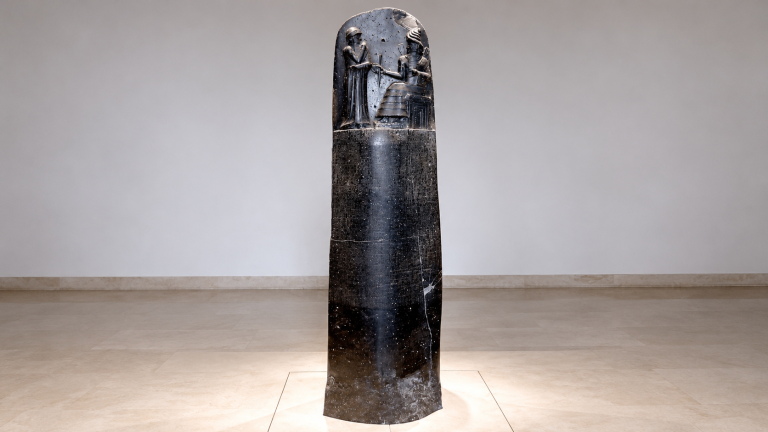
Justice already spoke other languages
“Our ideas of law, of virtue, of citizenship, and republican government were shaped in the Greek city-states.”
Much in this statement is sound. Greek thought profoundly shaped later European political language. The difficulty arises when an account of that inheritance becomes a claim to moral precedence over everyone else.
Egypt and the responsibility to uphold justice
In Egypt, maat brought together truth, justice, balance and right order. An object bearing the royal name of Amenhotep III, who ruled approximately 1386–1347 BCE, explicitly associates kingship with this principle. That was nearly a thousand years before Plato, approximately 427–347 BCE. The ruler’s authority was understood to carry a responsibility to uphold an order beyond his own wishes.
Persia and the restraint of authority
In Persia, Darius I, who ruled from 522 to 486 BCE, declared in his tomb inscription that he rejected injustice, restrained his anger and would not accept an accusation without hearing both parties.
These were a king’s claims about himself. They should be read critically. Yet they reveal the qualities through which he sought to justify his rule. Power was expected to show fairness, judgment and self-command.
China and the moral obligations of government
In China, Confucius, traditionally dated 551–479 BCE, made moral cultivation and exemplary conduct central to the responsibilities of authority. Mencius, active in the fourth century BCE, argued that good government must attend to the material conditions in which people lived.
None of these societies realised all its professed ideals. Neither did Athens. Their importance lies partly in the standards they formulated and the questions they left to later generations.
Justice did not have to wait for a Greek name before becoming a human concern.
Curiosity was never a Western monopoly
“Where others looked inward, the Greeks were the first to direct their focus outward”
The word “first” asks the reader to overlook rather a lot.
The Rhind Mathematical Papyrus, dated by the British Museum to about 1550 BCE, contains practical problems in calculation and geometry. It was itself copied from an older work. More than a millennium before Aristotle, 384–322 BCE, Egyptian scribes were preserving methods for measuring and calculating the world around them.
In China, Mozi, active around 430 BCE, and his followers developed arguments about moral standards and how claims could be justified. Later Mohist thinkers investigated geometry, mechanics and optics. Their work belongs to a tradition of enquiry that cannot be dismissed as inward-looking or intellectually incurious.
These traditions differed from Greek philosophy. Their differences make them worth studying. They do not make them lesser attempts at being Greek.
Rubio also contrasts Greek ambition with societies supposedly content with “stability and subsistence”. It is an odd dismissal. Feeding people, sustaining settlements and preserving knowledge are among the most difficult achievements of civilisation. Philosophy itself depends upon the conditions that allow people to practise it.
Excellence has more than one measure
“the highest and most noble aspiration in life was to surpass all others”
In Rubio’s account, the desire to excel becomes closely tied to the desire to prevail. Rivalry explains achievement, while greatness appears to be confirmed by victory.
Other ancient traditions ask a question that this account leaves insufficiently examined. What is excellence for?
Judging government through the lives of its people
For Mencius, a ruler should ensure that people were adequately fed and protected from violence. Material security helped make moral development possible. The quality of government could therefore be judged through the lives of those governed.
Leading without the burden of self-importance
Laozi, traditionally placed in the sixth century BCE, presents a different difficulty of dating. His historical identity remains disputed, while the Daodejing associated with him took shape over several centuries, including the fifth to third centuries BCE. Its reflections on government give particular weight to restraint, humility and the dangers of excessive interference.
Chapter 66 offers an image of leadership drawn from water. Rivers and seas receive the streams because they occupy the lower ground. The ruler earns support by avoiding the weight of self-importance and placing himself below those he leads.
There is ambition here, but it is an ambition to govern well. Its success cannot be measured simply by how far one person rises above the rest.
For readers in the twenty-first century, these are hardly obsolete concerns. They offer ways of thinking about achievement through responsibility, restraint and the consequences of our actions for other people.
Those who understood war also questioned its glory
“the ability to wield force when prudence and diplomacy fail.”
Egypt, Persia and China all knew conquest, military organisation and coercion. Their experience also produced reflection upon the limits of force.
The Art of War is traditionally attributed to Sun Tzu, conventionally placed around 500 BCE. His identity is uncertain, and scholars often date the text’s composition to the fourth century BCE. It places overcoming an enemy without battle above repeated victories in battle. Avoiding ruin can demonstrate greater ability than inflicting it.
This is strategic reasoning rather than pacifism. The distinction matters. Even within an argument about how to win, destruction need not be the highest accomplishment.
The Daodejing approaches the matter differently. Chapter 31 treats weapons as instruments of misfortune and victory involving mass death as an occasion for mourning. Winning does not release the victor from the obligation to recognise suffering.
The Mohists condemned military aggression while taking an active interest in defensive warfare. Protection and conquest were not morally interchangeable. Nor did the advantage gained by one community settle the question of justice towards another.
The ancient world left us arguments about the use of power, its purposes and its limits. An appeal to that inheritance must engage with the arguments, rather than borrow only their prestige.
Governing difference
“loyalty to your nation”
Rubio’s language makes the ancient world sound more familiar than it was. The Greek city-state was not a modern nation-state. Loyalty to one’s own community was important, but it could not answer every question raised by relations with other peoples.
The Persian experience of governing many peoples
The Achaemenid Persian Empire, approximately 550–330 BCE, extended from Egypt and Anatolia to Central Asia and the Indus region. Roads and provincial administration helped connect territories with different languages, institutions and religious traditions. Governing such an expanse required more than attachment to the conqueror’s identity.
Persian rule involved domination and unequal obligations. It also depended upon working with existing communities. The Cyrus Cylinder, issued after the conquest of Babylon in 539 BCE, describes the restoration of sanctuaries and the return of displaced populations and divine images. It was a royal declaration, rather than a charter of human rights. Its significance lies partly in the effort to establish authority through recognition of local religious life.
A wider education in political belonging
The Chinese thinkers considered here lived before imperial unification in 221 BCE, in a world of competing states. Their debates belonged to that setting. Later Chinese history would add centuries of experience in governing different regions and communities, through both accommodation and coercion.
Athens also ruled other communities. The comparison is therefore between different experiences of belonging and domination, each with its own possibilities and failures.
A history of civilisation should make room for the accumulated knowledge involved in governing difference. The assertion of loyalty is only the beginning of that problem.
Greatness seen through women’s lives
“the greatest civilization in the world.”
Greatest by whose measure, and for whom?
Women in classical Athens held important religious and social roles while remaining excluded from democratic decision-making. Egyptian history offers a different perspective on the relationship between civilisation and freedom.
Egyptian women and legal independence
Egyptian women could own and dispose of property, enter contracts and act in legal proceedings. They lived in a hierarchical society in which men predominated, but their independent legal capacity was substantially broader than that available to women in Athens.
Hatshepsut, who exercised pharaonic kingship approximately 1473–1458 BCE, ruled roughly a thousand years before the height of Athenian democracy. Her position was exceptional. Even so, Egypt had accommodated a woman at the summit of political authority long before Athens excluded women from its citizen assembly.
Persian women and economic authority
The Persepolis Fortification Tablets, principally dating to 509–494 BCE, provide evidence of Persian royal women controlling estates and workforces, alongside women supervising some labour groups.
The privileges of royal women should not be confused with the circumstances of every woman. Even so, the evidence shows that some women in Achaemenid Persia enjoyed considerable economic independence and managerial authority, with opportunities far beyond those generally available to women in classical Athens.
A civilisation cannot be assessed only through the lives of the men whom its institutions permitted to speak.
What a people inherits
“They were the characteristic of a people”
Rubio finds the qualities he admires in traditions,