
Empire Begins at Home
Renee Good and the Domestic Face of Power
Renee Good’s killing was not an accident, nor an isolated excess of force. It was a symptom. And like all symptoms, it appeared only after the disease had already advanced.
History is unambiguous on this point: dictatorships do not begin abroad. They do not start with foreign wars, distant invasions, or geopolitical chessboards. They begin at home. In the streets. In administrative offices. In visa forms. In the quiet normalization of fear.
Renee’s death was not the first warning. It may not even have been the penultimate one. There were earlier shots, earlier incidents, earlier moments when violence was tested and found acceptable. What has changed is not the capacity for repression, but the public’s tolerance for it.
From Citizenship to Exposure
Borders as Instruments of Control
Today, entering the United States as a European citizen is no longer a banal bureaucratic act. The old logic of trust attached to a passport has collapsed. Visas now demand total exposure: social media histories, networks, opinions, habits. The border no longer asks who you are, but how thoroughly you are willing to undress yourself for power.
Surveillance is no longer exceptional. It is procedural.
Control is no longer only internal. It is pre-emptive, exported, and normalised.
Minneapolis as a Warning Flare
Governing Through Intimidation
Inside the country, the escalation is sharper. Threats against governors. Open contempt for mayors. Federal agents operating under proclaimed “total immunity”. Cities waking up each morning to news that would once have belonged to another century.
Minneapolis has become the clearest warning flare: a major American city treated as hostile territory.
The threat to invoke the Insurrection Act is not a legal technicality. It is a signal. Snow-covered protests. Tear gas in sub-zero temperatures. Masked federal agents firing live rounds at civilians. This is not metaphor. This is domestic governance by intimidation.
Distraction as Method
What makes this moment especially dangerous is distraction. Greenland, Ukraine, Iran, Venezuela. Foreign noise fills the front pages while the internal front erodes. External crises still perform their oldest function: they pull attention outward while power consolidates inward.
And yet, the most revealing scenes are not military.
They are symbolic.
Submission as Spectacle
When Humiliation Becomes Strategy
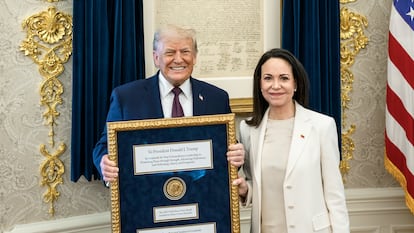
In the White House, submission has become performance. Foreign political figures no longer arrive to negotiate, but to offer themselves. Medals are brought not as symbols, but as currency. Meaning is emptied in public and called strategy.
The most extreme case is that of María Corina Machado, who chose to hand over her Nobel Peace Prize medal after being explicitly reminded that the prize itself is inalienable. In Spanish, the irony writes itself: Machado becomes manchando — staining what cannot be transferred.
The gesture was not diplomacy.
It was degradation.
A descent below political calculation, into voluntary abasement.
History will record that moment, as it will record others like it, including the spectacle of NATO’s Secretary General applauding power he was meant to contain. They will have their lines in the history books, but not the honorable ones.
The empire no longer demands loyalty alone.
It demands ritualised reverence, enacted publicly, so that humiliation itself becomes proof of alignment.
Corporate Kneeling and the Energy Stage
The Imaz Contrast
The same choreography unfolded in the energy sector. During a recent meeting at the White House, one European executive chose spectacle over substance. Jon Jozu Imaz managed, in a single appearance, to diminish himself and the company he represents Repsol. Faced with an administration that demands massive investment while eroding legal certainty, he offered compliance dressed as pragmatism.
There was an added layer of irony impossible to ignore. Imaz spent six months at the John F. Kennedy School of Government, an institution devoted, at least in theory, to leadership, public responsibility, and the ethical limits of power. And yet, when confronted with power in its rawest and most coercive form, he displayed no capacity to face it.
No distance.
No moral intelligence.
No understanding of how evil operates once it no longer bothers to disguise itself.
Beside him, the CEO of Exxon did something almost radical by today’s standards: he spoke plainly. He defended the need for security, legal stability, and rational investment conditions. No genuflection. No theatrics. Just a reminder that extracting resources at forty dollars a barrel while being asked to invest one hundred billion requires something more than obedience.
It requires rules.
The contrast was brutal. One executive reduced a former flagship of a European state to caricature. The other demonstrated that power still recognizes those who stand upright. The difference was not nationality or ideology.
It was posture.
How Authoritarian Systems Stabilize
This is how authoritarian systems stabilize themselves. Not only through force, but through voluntary abasement. Political leaders kneel. Corporate leaders comply. Institutions hollow themselves out in real time.
Renee Good’s name must not disappear beneath geopolitical headlines or diplomatic theatre. Her death marks a line in time. When citizens are killed by the state and the response is escalation rather than restraint, the question is no longer where the empire projects its power.
The question is how much violence it is prepared to exercise against its own people, and how many elites will assist by lowering their gaze.
Authority Without Self-Rule
An administration led by someone who cannot govern himself, who abuses the office entrusted to him and desecrates the very house he was elected to protect, cannot be trusted with authority beyond its own walls, let alone with the keys of the world.
2026 is not approaching quietly.
It is arriving with its intentions already visible.
The Theft of Dignity
And one final theft must be named plainly: this administration is not only exercising power. It is stealing something far older and far more fragile — Dignity.
A concept forged through centuries of philosophical struggle, articulated in the Renaissance, sharpened by the French Revolution, and placed at the heart of the American Declaration of Independence as the irreducible burden and birthright of every human being.
Those who are willing to trade dignity for a fistful of power, money, or pr