
Ten Plastic Kayaks on the Nile
A Small Incident at Al Haman
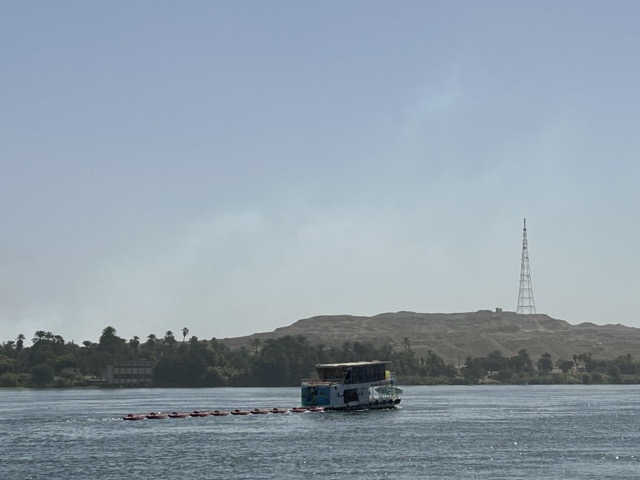
This week at Al Haman beach, near the temple of Gebel El Silsila, our felucca was anchored in calm water while tourists disembarked from a two-level motorboat, approximately fifteen meters long.
Behind it trailed ten plastic kayaks, tied together in a single line.
The boat chose to moor beside us. During the maneuver, the kayak line was laid directly across our radar structure.
Two hours later, when departure time came, the rope had wrapped itself into our equipment. Untangling it in midstream required our captain and at least two crew members. The Nile does not pause while one improvises.
This was not dramatic. It was revealing.
The Nile is not a decorative backdrop. It is an active navigation artery. Large cruise ships — some close to one hundred meters in length — regularly pass through this stretch. An unresolved entanglement in the middle of the channel is not a minor inconvenience. It is a navigational risk.
What appears harmless — ten lightweight plastic kayaks — can become hazardous in a working river.
Upper Egypt: Inheritance, Not Absence
For three years I have travelled throughout Egypt, from north to south, through Upper Egypt and deep into the desert — including places that many urban Egyptians have never visited.
In the desert, Bedouin communities care for their land because it is home. The sky filled with stars above them today is the same sky that shone above Ramses II. Continuity here is not a slogan; it is lived reality.
Upper Egypt is frequently described as less modern.
Yet what exists in Upper Egypt is not absence. It is inheritance.
The Nile is not scenery. It is memory, livelihood, discipline, and accumulated intelligence.
Children of the river grow up observing currents, wind shifts, and boat spacing. They learn caution long before they learn terminology. This knowledge is not acquired in a weekend excursion. It is formed over generations.
Tourism increasingly speaks the language of immediacy — of scale, access, volume, and speed. It promises sunsets and compressed experiences.
But a millennium of river literacy cannot be absorbed in one evening beside a fire with tea.
The difference is not between rural and urban. It is between continuity and acceleration.
Plastic, Power, and Perspective
Plastic kayaks are not inherently problematic. They are practical and affordable. Yet plastic carries with it a culture of disposability. What floats today is assumed to disappear tomorrow.
The Nile already bears a growing burden of plastic waste — bottles, packaging, fragments along its banks. Tourism, when expanded without strict environmental discipline, contributes to this accumulation.
Revenue concentrates upward. Waste drifts downstream.
For centuries and beyond, Egypt was the breadbasket of the great Roman Empire. The Nile fed an empire. Grain ships left its shores to sustain millions. This river nourished power, stability, and civilization on a continental scale.
A river that fed an empire should not be reduced to recreational convenience.
The tension between celebrated development and locally absorbed cost is not new. It has been observed before in analyses of how large economic narratives often leave environmental and social burdens behind, as described in this 2014 reporting in El País. – El barrio del millón de basureros
The Nile existed before us. It carried stone for temples, grain for Rome, and life for entire regions. Great civilizations rose because this river was respected and understood.
A twenty-first-century rush, governed by minute-by-minute scrolling and short-term gain, risks eroding what thousands of years built.
Yet we are still in time.
Village communities along the Nile already do what they can. They collect waste from beaches with their bare hands. They care for their stretches of river not because policy compels them, but because the river sustains them.
More environmental education is needed. Clearer regulation is needed. Greater discipline from tourism operators is needed.
But the foundation is present.
When coming to the Nile — and to Egypt as a whole — we should remember that we are entering a landscape that shaped the ancient world long before modern tourism existed.
Ten plastic kayaks may seem insignificant.
But civilizations, too, are shaped by the accumulation of small decisions.

