
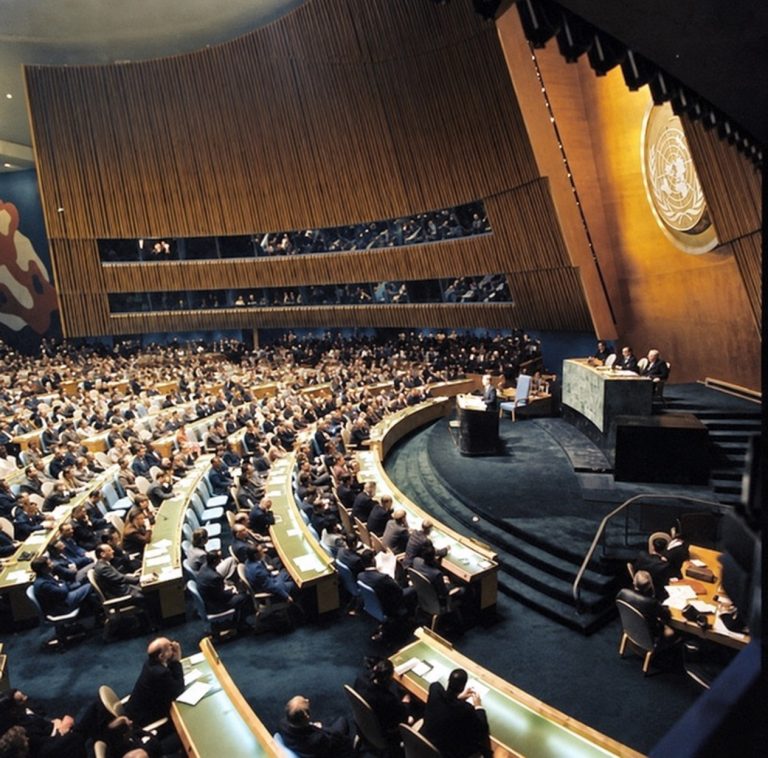
Two speeches at the United Nations, sixty-three years apart, reveal profoundly different understandings of power, responsibility and humanity’s future.
On 20 September 1963, John F. Kennedy delivered his last address to the United Nations General Assembly. Just two months later, on 22 November, he was assassinated in Dallas.
For me, the first questions about that assassination remain: why, and for what purpose? Identifying the person who fired the shots does not, by itself, explain the motive. Although the Warren Commission concluded that Lee Harvey Oswald acted alone, it acknowledged: “The Commission could not make any definitive determination of Oswald’s motives.” (Warren Commission report)
And if someone else directed the killing, there would be the further question expressed in German criminal-law terminology as der Täter hinter dem Täter: the perpetrator behind the perpetrator. Asking that question does not establish who such a person might have been.
The speech Kennedy left us deserves attention in its own right, especially when set beside the words spoken from the same podium today.
Kennedy: choosing peace in the shadow of nuclear war
Kennedy spoke in a world divided by the Cold War. Only eleven months earlier, the Cuban missile crisis had brought the United States and the Soviet Union to the brink of nuclear catastrophe. The danger was something he had confronted directly. (National Archives account)
By September 1963, Kennedy described a period of “comparative calm”. He understood how fragile it was and urged governments to use the opportunity: pursue arms control, strengthen international cooperation and turn the recently signed nuclear test-ban treaty into a beginning.
For me, this is the essential demonstration of leadership: having confronted the possibility of nuclear catastrophe, Kennedy chose to plead for peace and cooperation with the adversary.
His proposals gave that commitment substance. He called for further agreements, stronger international institutions and even cooperation with the Soviet Union on a mission to the Moon. He recognised that accumulating destructive power did not necessarily make people safer.
His appeal was clear:
“It is never too early to try; and it’s never too late to talk.”
That willingness to negotiate, despite profound disagreement, is the standard against which the comparison should be made. (Kennedy’s complete address)
Trump: survival becomes an ultimatum
Trump also speaks of peace, usually between threats to annihilate another country.
At the United Nations on 22 September 2026, he raised the possibility of annihilating the Islamic Republic and leaving it with “no chance of survival”. Those words concern a country inhabited by more than 90 million people—people whose lives cannot be reduced to their government or treated as the disposable material of presidential threats. (UN speech coverage, UNFPA population data)
A country contains children, families, memories, disagreements and generations yet to come. Its survival should never become a bargaining device. The language of annihilation makes a mockery of the speaker’s pretensions to peacemaking.
Nearly 47 years of sanctions before this threat
The suffering of ordinary Iranians began long before this speech. The history of successive US sanctions stretches back to November 1979—nearly 47 years. Their scope and severity have changed, but economic pressure has remained a recurring instrument of US policy towards Iran. (National Archives, US Treasury sanctions history)
The human consequences cannot be dismissed as an unfortunate footnote. Following her 2022 visit, an independent UN human rights expert reported that sanctions, restrictions affecting third parties, and businesses’ excessive avoidance of transactions aggravated Iran’s humanitarian and economic difficulties, particularly for the most vulnerable. (UN account of the findings)
These are people who have already endured years of restricted opportunities and economic hardship. Now they hear an US president contemplate their country’s annihilation. Apparently, the promised road to peace requires ordinary Iranians to endure economic suffocation before being invited to contemplate destruction.
A region already devastated
Look at Palestine, above all Gaza: homes, hospitals, schools and livelihoods devastated on an extraordinary scale. Look at Lebanese villages demolished by Israeli forces. Look at southern Syria, where UN investigators describe Israeli incursions, destroyed homes and agricultural livelihoods, and civilians unable to move freely through their own communities. These consequences are already visible. (UN Gaza assessment, reporting from southern Lebanon, UN investigators on Syria)
Iraq belongs in this reckoning too: the US-led invasion and its disastrous aftermath remain a warning about what happens when military power outruns evidence, diplomacy and responsibility for the people who must live with the consequences. The Iraq Inquiry found that peaceful options had not been exhausted before war. (Official statement on the inquiry)
And now Iran is presented as another country whose future can be threatened from a podium. How many devastated societies must this region endure before its people’s right to live finally outweighs another government’s ambitions?
Iran’s president: the weapons are in Israel, the inspectors in Iran
In the UN address excerpt included in the three interviews, Iranian President Masoud Pezeshkian puts the accusation of double standards plainly. In the English interpretation heard in the recordings, he says:
“Atomic and nuclear bombs are in the hands of the Israeli regime, but the inspectors are requested to come to Iran.”
His intervention forces an uncomfortable issue into the discussion: how credible is a demand for regional nuclear security when the standards applied to different states are so unequal?
There is a concrete institutional distinction behind his argument. Iran is a party to the Nuclear Non-Proliferation Treaty and has a comprehensive safeguards agreement with the International Atomic Energy Agency. Israel remains outside that treaty and has limited safeguards arrangements, rather than comprehensive safeguards covering its nuclear activities. (IAEA record for Iran, IAEA record for Israel)
Preventing nuclear catastrophe requires consistent scrutiny and restraint. A system whose credibility depends on overlooking an ally’s arsenal while threatening an adversary cannot expect its appeals to mutual trust to go unchallenged.
Sachs, Wilkerson and Blumenthal: three connected criticisms
The interviews with Jeffrey Sachs, Colonel Lawrence Wilkerson and Max Blumenthal on Andrew Napolitano’s Judging Freedom approach Trump’s address from different directions. Together, they raise questions about presidential power, military strategy and the interests served by policies presented as a pursuit of peace.
Prof. Jeffrey Sachs: unchecked presidential power
In his interview with Jeffrey Sachs, Napolitano asks about the threat against Iran. Sachs’s central concern is that a president can speak as though the survival of another civilisation were his personal decision.
Sachs directs his criticism at the institutions that should restrain that power. He invokes Congress’s responsibilities over war and public spending, arguing that the failure to challenge presidential threats exposes a breakdown in constitutional accountability.
He also recalls Kennedy’s final UN address and his pursuit of agreement with the Soviet Union after the Cuban missile crisis. For Sachs, that example demonstrates the kind of US leadership capable of earning international respect through cooperation.
His argument leaves a question that should trouble anyone listening: where are the institutions capable of stopping a president who talks this way?
Col. Lawrence Wilkerson: threats without a coherent strategy
In his interview with Colonel Lawrence Wilkerson, Napolitano asks whether Trump’s Iran strategy is backfiring. Wilkerson questions whether there is a coherent strategy at all.
He describes an approach that oscillates between threats of destruction and assurances that negotiations are going well. In his assessment, such conduct deepens distrust and undermines the possibility of a durable agreement.
He also argues that bombing can strengthen a population’s support for resistance. The ability to inflict devastation does not automatically produce the political outcome the attacker wants.
Wilkerson nevertheless defends the United Nations as indispensable. Even deeply flawed institutions provide a place where adversaries can confront one another through words and diplomacy. The spectacle of threats from its podium makes that function more necessary.
Max Blumenthal: domination in the language of peace
In his interview with Max Blumenthal, Napolitano examines the wider political message of Trump’s speech.
Blumenthal disputes Trump’s presentation of US successes and interprets the pressure on Iran, developments in Venezuela and proposals for Gaza as parts of a broader pursuit of domination. His criticism centres on who controls resources, who determines reconstruction and whether the affected populations retain meaningful authority over their own futures.
He challenges the presentation of outside political and commercial control as benevolent assistance. His analysis asks whose interests are served when the people living with destruction have the least influence over what follows.
Blumenthal also questions the UN’s dependence on its US host and argues for relocating it. Where Wilkerson stresses the institution’s indispensability, Blumenthal emphasises the conditions necessary for its independence.
Across these interviews, the recurring questions are clear: who restrains power, whose interests do these wars serve, and what voice remains for the people expected to endure them?
What should greatness mean?
In my judgement, Trump is putting US power at the service of Netanyahu’s war agenda, with contempt for the human cost and the consequences beyond the region. He remains fully responsible for that choice.
Israel’s security does not confer a right to devastate another country. Netanyahu’s objectives do not constitute a mandate from humanity. No government is entitled to demand that everyone else absorb the consequences of its wars.
How much longer must the rest of the world pay for the insecurities and pharaonic ambitions of Israel’s government? How does a geographically small state’s claim to security become an apparently limitless claim on other nations’ lives, resources and futures?
The costs reach far beyond the battlefield. Disruption to energy, food, fertiliser, transport and trade passes into household budgets and livelihoods, with poorer countries and families especially exposed. People thousands of kilometres away are handed the bill for wars they did not choose. (IMF analysis)
This is where Kennedy’s example matters most. Having confronted the possibility of nuclear catastrophe during the Cuban missile crisis, he used his final UN address to pursue negotiation and cooperation. He understood that overwhelming power carried an obligation to make a shared future possible. (JFK’s address)
Greatness should be measured by the lives power protects, the catastrophes it prevents and the possibilities it opens. Repeating the word peace cannot disguise a politics that makes another nation’s survival conditional on obedience.
The world’s future does not belong to Trump or Netanyahu. It belongs to we, the people who have to live in it.